
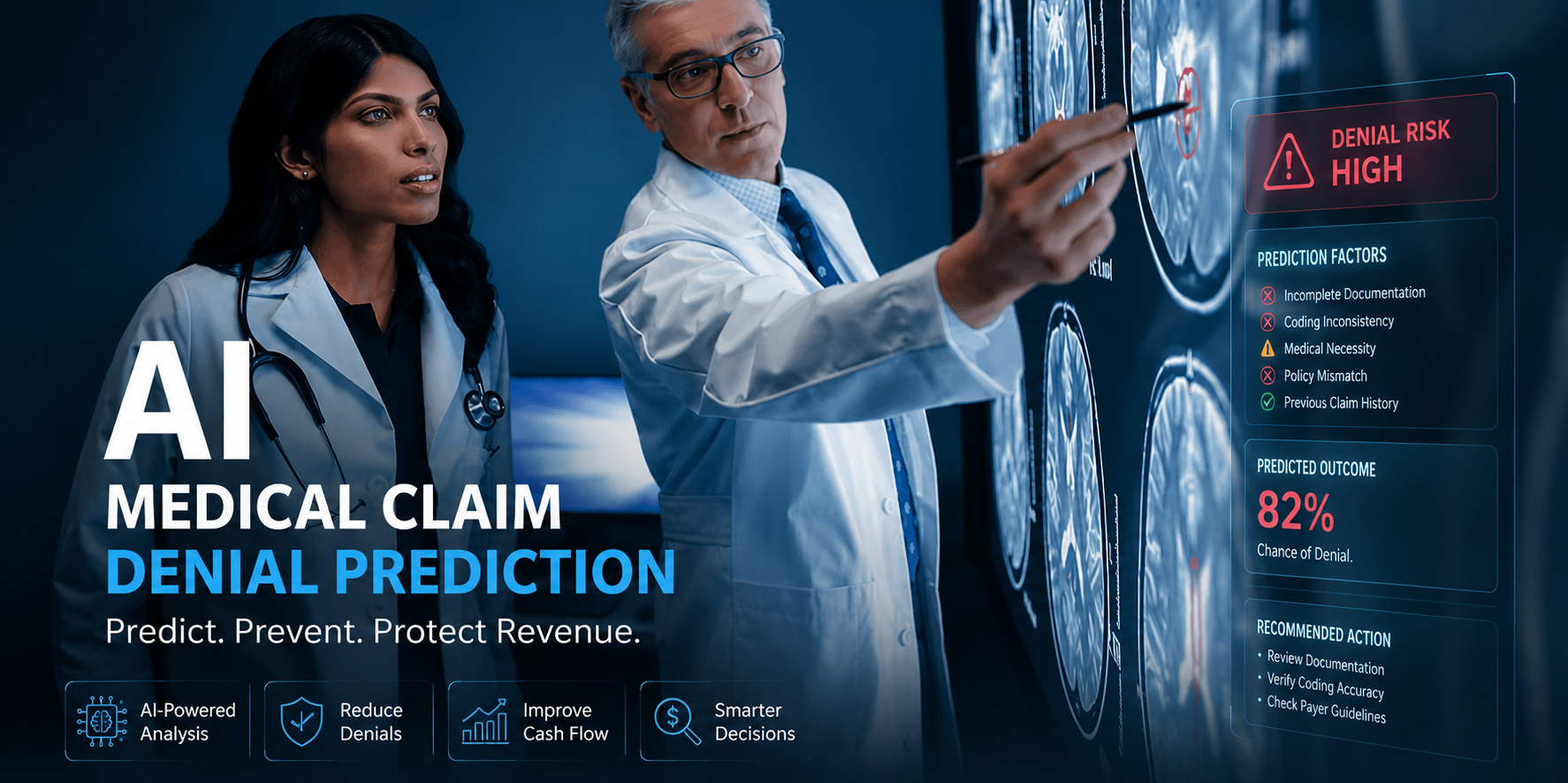
Medical claim denials continue to be one of the biggest revenue challenges for healthcare providers. A claim may be denied because of eligibility issues, coding mistakes, missing information, authorization problems, documentation gaps, or payer-specific requirements. By the time a denial appears, the practice has already invested time and resources in processing the claim.
In 2026, healthcare organizations are increasingly turning to Artificial Intelligence (AI) and predictive analytics to identify potential problems before a claim is submitted.
Instead of waiting for payers to reject claims, AI-powered revenue cycle management can analyze historical and real-time data to identify claims that have a higher probability of denial. This allows billing teams to correct issues proactively and improve the likelihood of first-pass payment.
What Is AI-Powered Claim Denial Prediction?
AI-powered denial prediction uses machine learning, historical claim data, payer patterns, coding information, patient information, and other relevant RCM data to identify potential denial risks.
The system can evaluate a claim before submission and flag issues such as:
- Incorrect or incomplete patient information
- Insurance eligibility problems
- Missing prior authorization
- Coding inconsistencies
- Modifier-related issues
- Documentation gaps
- Payer-specific billing requirements
- Duplicate claims
- Medical necessity concerns
- Missing or invalid claim information
The goal is simple: identify potential problems before the payer identifies them.
How Does AI Predict a Potential Claim Denial?
AI does not simply look for one error. It can analyze multiple data points simultaneously and identify patterns that may indicate a claim is likely to be denied.
1. Analyzing Historical Claim Data
Historical claims provide valuable information about what has happened in the past.
AI can analyze previous paid and denied claims to identify patterns such as:
- Which payers frequently deny specific services
- Which CPT or HCPCS codes are associated with denials
- Which diagnosis-code combinations create problems
- Which providers or locations experience higher denial rates
- What types of documentation issues repeatedly cause rejections
This historical intelligence can help the billing team recognize similar risks in future claims.
2. Identifying Payer-Specific Patterns
Different insurance companies can have different policies, documentation requirements, authorization rules, and claim-processing behaviors.
AI systems can analyze payer-specific data and flag claims that resemble previously denied claims.
For example, if a particular payer frequently denies a service when prior authorization is missing, the system can flag that claim before submission.
3. Detecting Coding Inconsistencies
Coding errors are a common source of claim problems.
AI can evaluate relationships between:
- CPT codes
- HCPCS codes
- ICD-10 diagnosis codes
- Modifiers
- Place of service
- Provider information
- Patient information
If the data appears inconsistent, the claim can be flagged for review before submission.
This does not eliminate the need for professional medical coders. Instead, AI can help coders focus their attention on claims that require closer examination.
4. Checking Eligibility and Coverage Risks
A claim can be correctly coded and still fail because the patient’s insurance information is incorrect or coverage is inactive.
AI-powered workflows can combine eligibility information with historical patterns to identify potential coverage-related risks.
For example, a system may flag:
- Inactive coverage
- Incorrect member information
- Coverage changes
- Coordination-of-benefits issues
- Services that may not be covered under the patient’s plan
Resolving these issues before submission can reduce avoidable denials.
5. Predicting Authorization Problems
Prior authorization remains a major administrative challenge for many healthcare practices.
AI can compare the planned service against historical authorization requirements and identify claims that may require additional documentation or authorization.
Instead of discovering an authorization problem after the claim is denied, the billing team can investigate the requirement earlier.
6. Assigning a Denial Risk Score
One of the most useful capabilities of predictive analytics is the ability to assign claims a risk score.
For example, an AI system could categorize claims as:
- Low risk: Likely to process successfully
- Medium risk: Requires review
- High risk: Significant potential for denial
High-risk claims can be routed to experienced billing or coding specialists before submission.
This creates a more efficient workflow because staff do not have to manually investigate every claim with the same level of attention.
Why Predicting Denials Before Submission Matters
Traditional denial management is often reactive.
A payer denies a claim → the billing team investigates → the issue is corrected → the claim is resubmitted → payment is delayed.
Predictive denial management changes that workflow:
Potential problem → AI identifies risk → billing team reviews claim → error is corrected → claim is submitted
This proactive approach can provide several advantages.
Fewer Avoidable Denials
The earlier an error is identified, the easier it can be to correct.
Preventing an avoidable denial also eliminates the additional administrative work associated with appeals, corrections, and resubmissions.
Faster Reimbursement
Clean, accurate claims have a better chance of moving through the payer’s process without unnecessary delays.
Reducing preventable issues can help practices improve cash flow and reduce the time between service delivery and reimbursement.
Lower Administrative Costs
Every denied claim can require additional staff time.
Employees may need to research the denial, contact the payer, correct the claim, document the issue, and resubmit it.
Preventing denials can reduce this repetitive administrative workload.
Better Revenue Visibility
Predictive analytics can help practice leaders understand where revenue problems are developing.
Instead of looking only at historical denial reports, managers can identify potential risks before they affect future collections.
AI Does Not Replace Medical Billing Professionals
AI can significantly improve the RCM process, but it should not be viewed as a complete replacement for experienced billing and coding professionals.
Healthcare claims involve complex clinical, coding, payer, and regulatory considerations. Human expertise remains important for reviewing unusual cases, interpreting complex documentation, and making final decisions.
The strongest approach is often AI + experienced RCM professionals.
AI identifies patterns and potential risks.
Professionals review the findings, validate the information, and take the appropriate action.
What Data Does AI Need to Predict Denials?
The quality of an AI prediction depends heavily on the quality of the data being analyzed.
Depending on the system and workflow, relevant information may include:
- Patient demographics
- Insurance information
- Eligibility results
- CPT and HCPCS codes
- ICD-10 codes
- Modifiers
- Provider details
- Place of service
- Prior authorization information
- Clinical documentation
- Historical claims
- Historical denial reasons
- Payer-specific patterns
- Payment and reimbursement history
Better data can help predictive models identify more meaningful patterns.
How Practices Can Implement Predictive Denial Management
Healthcare organizations do not necessarily need to completely replace their existing RCM processes to benefit from predictive analytics.
A practical implementation can begin with a few key steps.
Step 1: Analyze Current Denials
Start by identifying the most frequent denial categories and the payers responsible for them.
Step 2: Identify High-Impact Problems
Focus on denial types that create significant financial or administrative losses.
Step 3: Integrate Relevant Data
Connect appropriate billing, eligibility, coding, authorization, and claims data so potential risks can be evaluated more effectively.
Step 4: Establish Pre-Submission Checks
Use predictive tools to flag high-risk claims before they reach the payer.
Step 5: Monitor Results
Track metrics such as:
- Claim denial rate
- First-pass acceptance rate
- Clean claim rate
- Days in A/R
- Net collection rate
- Appeal rate
- Rework volume
Step 6: Continuously Improve the Model
Payer policies and claim patterns can change. Predictive systems should therefore be continuously monitored and updated based on new claim outcomes.
The Future of AI in Medical Revenue Cycle Management
AI is moving healthcare RCM from a primarily reactive model toward a more predictive approach.
Traditional RCM asks:
“Why was this claim denied?”
Predictive RCM asks:
“Is this claim likely to be denied, and what can we do before submission?”
That shift can help healthcare organizations become more proactive about revenue protection.
As AI, automation, and analytics continue to develop, practices may increasingly use predictive tools across eligibility verification, coding validation, prior authorization, claim scrubbing, denial prevention, payment analysis, and accounts receivable management.
Conclusion
Medical claim denials can negatively affect cash flow, increase administrative workload, and delay reimbursement. AI-powered predictive analytics offers healthcare practices a proactive way to identify potential denial risks before claims are submitted.
By analyzing historical claims, payer behavior, coding information, eligibility data, authorization requirements, and other RCM factors, AI can help billing teams prioritize high-risk claims and address potential problems earlier.
However, technology works best when combined with experienced medical billing professionals. The goal is not simply to automate billing—it is to build a smarter revenue cycle that identifies problems earlier, reduces preventable denials, and helps practices protect their revenue.


