
Running a successful medical practice requires more than providing excellent patient care. Your practice also needs a healthy revenue cycle to ensure that the services you provide are properly billed, reimbursed, and collected.
Many practices monitor total revenue, but revenue alone does not tell you where money is being delayed or lost. Tracking the right Revenue Cycle Management (RCM) metrics can reveal problems with claims, accounts receivable, denials, and collections before they become major financial issues.
The American Academy of Family Physicians identifies Days in A/R, adjusted collection rate, and denial rate as important revenue-cycle measures for evaluating practice financial performance.
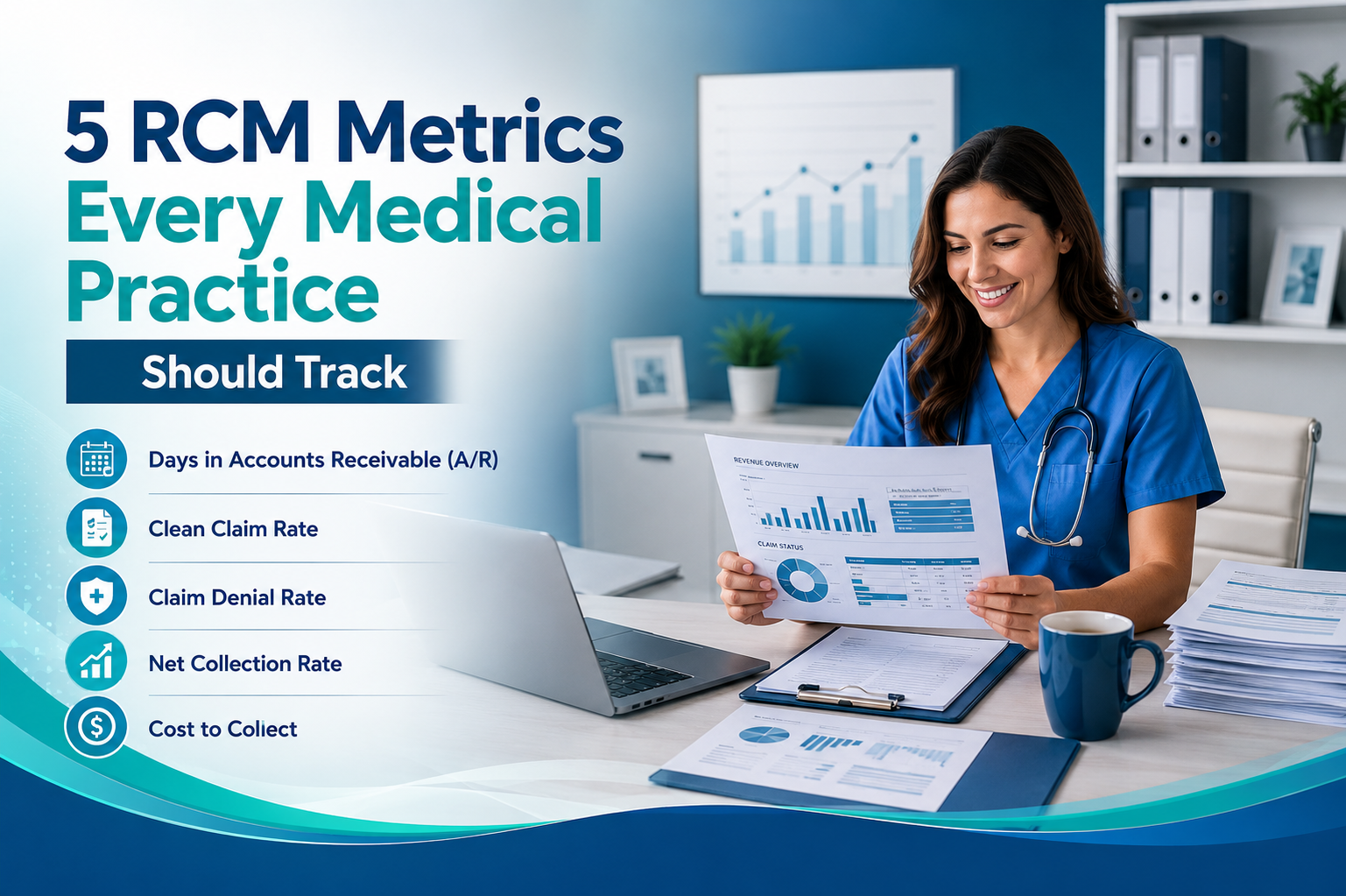
Here are five critical RCM metrics every medical practice should monitor.
1. Days in Accounts Receivable (A/R)
Days in A/R measures approximately how long it takes your practice to collect outstanding payments after services are provided.
A high A/R days number can indicate that claims are taking too long to process, denials are not being worked quickly enough, or unpaid patient balances are accumulating.
Why Days in A/R Matters
When money remains in A/R for too long, your practice may experience:
- Reduced cash flow
- Increased administrative workload
- Growing aged A/R
- Higher risk of timely-filing issues
- Difficulty forecasting revenue
- More unpaid or underpaid claims
Industry guidance commonly places a well-managed physician practice around 30–40 days in A/R, although the appropriate target can vary by specialty, payer mix, and practice model.
Lead-generation angle: If your practice has consistently high A/R days, a professional billing team can analyze aging accounts, identify bottlenecks, and prioritize outstanding claims.
2. Clean Claim Rate
Your clean claim rate measures the percentage of claims submitted correctly the first time without requiring corrections or additional work.
A strong clean claim process helps practices receive reimbursement faster and reduces unnecessary administrative work.
Common Causes of Unclean Claims
Claims may be rejected or delayed because of:
- Incorrect patient information
- Eligibility problems
- Coding errors
- Missing modifiers
- Incorrect payer information
- Authorization issues
- Incomplete documentation
- Provider credentialing problems
A frequently cited target for clean claims is 95% or higher, although benchmarks vary depending on specialty and methodology.
The AMA also identifies clean claim submission as an important RCM performance indicator because claim accuracy directly affects reimbursement and payment delays.
Why It Matters
Every avoidable claim error can create additional work for your billing staff and delay payment.
Improving your clean claim rate means fewer corrections, fewer delays, and a smoother path from patient visit → claim submission → reimbursement.
3. Claim Denial Rate
The denial rate shows how frequently submitted claims are denied by payers.
This is one of the most important metrics for identifying revenue leakage.
A practice may have a large number of claims going out every month, but if a significant percentage are denied, substantial revenue can become trapped in the billing process.
Common Reasons for Denials
Denials can result from:
- Eligibility issues
- Prior authorization problems
- Incorrect coding
- Medical necessity issues
- Missing information
- Duplicate claims
- Incorrect modifiers
- Timely filing problems
- Coverage limitations
A commonly used goal is to keep denial rates below 5%, although actual benchmarks vary by specialty, payer mix, and how denials are defined.
Don’t Just Track Denials — Track Their Causes
Knowing that your denial rate is increasing is useful.
Knowing why it is increasing is much more valuable.
For example:
Denial rate increased → eligibility denials increased → front-end verification issue identified → verification workflow corrected.
This turns RCM reporting into an actionable improvement strategy.
4. Net Collection Rate
The net collection rate measures how effectively your practice collects the reimbursement it is contractually entitled to receive.
This is more meaningful than simply looking at total collections because it helps determine whether your practice is actually collecting the money it should.
A commonly referenced target is approximately 95% or higher, with some best-practice guidance targeting 97–99%.
A Low Net Collection Rate May Indicate:
- Unworked A/R
- Underpayments
- Poor denial follow-up
- Incorrect contractual adjustments
- Uncollected patient balances
- Missed billing opportunities
- Weak payment posting processes
For example, if your practice is consistently generating strong charges but your net collection rate is falling, the problem may not be patient volume — it may be revenue that is not being fully captured.
5. Cost to Collect
The fifth metric many practices overlook is cost to collect.
Cost to collect evaluates how much your practice spends to generate each dollar of collected revenue.
This can include:
- Billing staff salaries
- Billing software
- Clearinghouse fees
- Outsourced billing expenses
- Administrative labor
- Claim correction costs
- Denial management labor
- Collection-related expenses
A practice can have increasing collections while still becoming less efficient if the cost of generating those collections is rising faster.
Why This Metric Matters
Tracking cost to collect helps practice owners answer an important question:
“Are we collecting more money efficiently, or are we simply spending more money to collect it?”
This is particularly important when comparing in-house billing vs. outsourced medical billing.
RCM Metrics at a Glance
| RCM Metric | What It Measures | Why It Matters |
|---|---|---|
| Days in A/R | How quickly outstanding A/R is collected | Measures cash-flow efficiency |
| Clean Claim Rate | Claims accepted correctly on first submission | Reduces delays and rework |
| Denial Rate | Percentage of claims denied | Identifies revenue leakage |
| Net Collection Rate | Percentage of collectible revenue actually collected | Measures billing effectiveness |
| Cost to Collect | Cost associated with generating collections | Measures RCM efficiency |
Why Tracking RCM Metrics Is Not Enough
Simply creating a monthly report isn’t going to improve your revenue cycle.
Your team needs to identify trends, investigate the causes, and take corrective action.
For example, suppose your practice reports:
- A/R days increasing
- Denials increasing
- Clean claim rate declining
- Net collections decreasing
These numbers together tell a much stronger story than any single metric.
They may indicate problems somewhere between registration, eligibility verification, coding, claim submission, denial management, payment posting, and A/R follow-up.
The goal should be to create an RCM dashboard that your practice reviews consistently and uses to make operational decisions.
How Often Should Medical Practices Review RCM Metrics?
At minimum, practices should review their core RCM metrics monthly and monitor important changes throughout the month.
Monthly trending can help identify whether performance is:
- Improving
- Declining
- Staying consistent
- Moving outside your target range
The key is to compare your numbers over time rather than looking at one month’s performance in isolation.
What Happens When RCM Metrics Are Ignored?
Small revenue-cycle problems can compound.
A few incorrect claims may not seem significant. But when similar problems occur across hundreds or thousands of claims, the financial impact can become substantial.
For example:
Coding issue → claim rejection → delayed payment → increased A/R → additional staff work → higher collection costs.
Without proper KPI tracking, practices may not recognize the pattern until cash flow is already affected.
Turn Your RCM Data Into Better Revenue Performance
Your RCM metrics should do more than populate a spreadsheet. They should help you identify where revenue is being delayed, denied, or lost.
A professional RCM partner can help your practice monitor key performance indicators, identify recurring billing problems, improve claim accuracy, manage denials, and strengthen A/R follow-up.
At USRCM, the goal isn’t simply to submit claims. It’s to help medical practices build a more efficient revenue cycle and improve the financial performance of their billing operations.
Is Your Practice Tracking the Right RCM Metrics?
If you don’t know your current A/R days, clean claim rate, denial rate, net collection rate, or cost to collect, you may be missing important revenue-cycle problems.
USRCM can help you evaluate your billing performance and identify opportunities to improve collections.


